
Montessori Toddler Program · 1.8–3 years
A gentle beginning to independence
A calm, prepared environment where children develop independence, confidence, language, self-care and a lifelong love of learning.
“Help me do it myself.”
- Age
- 1.8 to 3 years
- Focus
- Movement · Language · Independence
- Approach
- Prepared Montessori environment
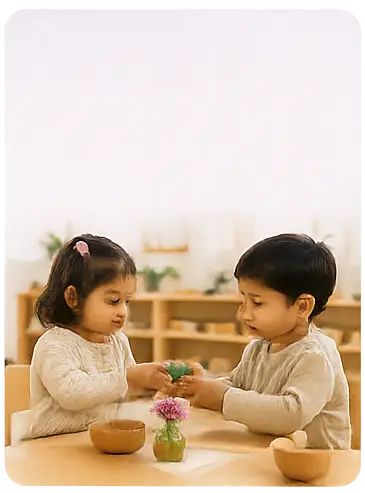
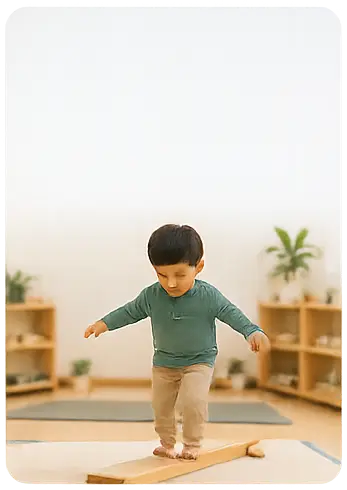
Small hands. Serious concentration.
1.
The Montessori Toddler Program
The Freethinking School, a part of early childhood Montessori education, requires a child to be a confident walker to be eligible for enrollment. In this private early childhood education setting, a maximum of 7 children can learn from and assist each other under the careful supervision of a trained teacher and assistants.
As with most aspects of Montessori education, early experiences in this community are thoughtfully designed to prepare children for years of future growth. The staff’s responsibility is to observe and follow each child to determine how best to aid in their individual needs, to create a classroom environment where children can operate freely and independently, and to model and guide the development of respect for all people, nature, and materials.
The Freethinking School is committed to working in partnership with families to support each area of development for every child physical, social, emotional, and intellectual.
Development from 1.8 to 3 years
The foundations of lifelong learning
Growing Independence
Children are empowered to do more for themselves each day. They learn to make choices, care for their belongings, complete tasks independently, and take care of their environment and one another.
Finding Their Voice
Children are immersed in a language-rich environment filled with stories, conversations, songs, and meaningful experiences. Their vocabulary expands as they become confident expressing thoughts, needs, and ideas in multiple languages.
Learning to Concentrate
Montessori activities naturally capture interest and encourage deep engagement. Children develop the ability to focus, persist with tasks, and experience the satisfaction of completing meaningful work independently.
Growing Socially and Emotionally
Children develop confidence, empathy, self-regulation, and positive social skills as they learn to work, communicate, and collaborate within a caring community.
Developing Self-Care Skills
Daily routines help children become increasingly independent in caring for their own needs, including handwashing, dressing, eating independently, managing belongings, and developing toileting independence with dignity and support.
Building Early Literacy Skills
Through Montessori language materials, children develop phonemic awareness, enrich vocabulary, strengthen listening skills, and begin connecting sounds to symbols. These experiences prepare the hand for writing and the mind for reading.
Building the Mathematical Mind
Through hands-on materials, children explore patterns, relationships, sequencing, classification, and quantity. These experiences lay the foundation for logical thinking and future mathematical understanding.
Developing the Thinking Mind
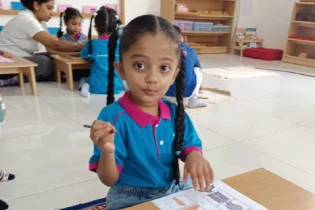
Through purposeful exploration and hands-on learning, children strengthen concentration, memory, reasoning, problem-solving, and independent thinking.
Practical Life · purposeful activity
2.
“I can do it myself.”
Children are empowered to do more for themselves each day.
They learn to make choices, care for their belongings, complete tasks independently and take care of their environment and one another. Carrying, pouring, transferring, arranging and cleaning transform everyday actions into meaningful work.
- 1 Care for self
- 2 Care for the environment
- 3 Coordinated movement
- 4 Completion and restoration
Learning experiences
Purposeful experiences for lasting growth
Four connected experiences support the child’s development within a carefully prepared Montessori community.
Building Community
Equally important to the physical environment (the classroom and the materials), is the psychological and social environment we provide for the children. The adults in each community must be the very best models of language, movement, and social relationships.
The multi-age community also allows children to learn a great deal from one another. The young child who first enters the community benefits from having peer role models in the classroom, while the oldest children have the opportunity to experience being a leader and a helper.
The classroom is a place of respect. Everything is child-sized—from the custom-made tables and chairs to the shelves, vases, plates and utensils, and even toilets. In an environment that offers such appropriately-sized opportunities, children are expected to take on greater responsibilities for taking care of themselves and others.
Gaining Independence
The Freethinking School supports the drive towards independence: “Help me do it myself.” Children gravitate toward activities that develop motor skills: running, carrying, climbing, or swinging; grasping knobs, wielding shovels, handling paintbrushes, or petting animals. Control of their own bodies heralds a control of self, including the ability to dress, eat, and toilet independently.
Children in the Freethinking School communities are at an age where they are learning to do more and more for themselves. We support their quest towards independence by allowing the child to do all they are capable of doing. Our environments are laid out to support this desire for autonomy, with child-sized furniture and activities specifically designed for independent practice.
A young child’s brain is growing at a tremendous pace. Just look at language development. Within six years, children develop from infancy (from the Latin for, literally, “not speaking”) to fluency in their native language; few adults can claim such speed or success!
Both Dr. Montessori’s observations and modern brain imaging show that the young child’s brain is a source of enormous potential and promise, where neural pathways in regular use are reinforced and those ignored or neglected are pruned away. Each of those brain connections is a platform for future learning. Shouldn’t we make sure children have as varied and stimulating an environment as possible, to give scope to all their talents?
“Children can do much more than we expect.”
Gross Motor Development
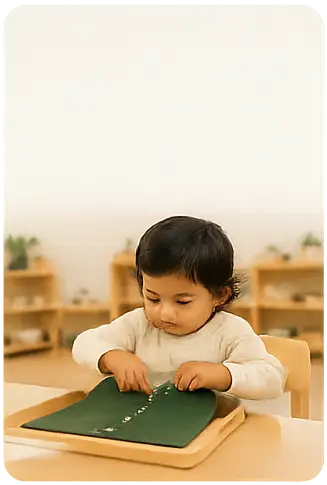
Children between the ages of 1.8 and 3 years spend much time working on the refinement of movement. In the Montessori Toddler Program, movement is encouraged and constant. Much learning takes place through movement in the development of muscular memory. Many activities are designed to promote movement in the setup and performance of the work.
The activities of practical life are those that are common in daily activities that all human beings do for their own well-being and for the care of their environment. Just as the child absorbs the language around them, they also absorb these activities from the environment around them and then decide to imitate the adult and reproduce the activity.
The Next Step
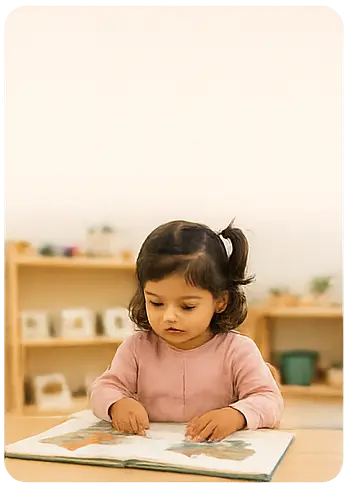
When they are ready, in terms of personal independence and social readiness, students move up from the Montessori Toddler Program to the Montessori Primary Program (ages 3 to 6).
A predictable flow
A rhythm toddlers can trust
A recognisable sequence gives the child security without making every moment rigid. Exact routines vary by environment; this illustrates the developmental flow.
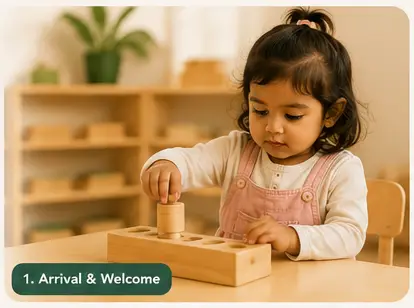
- 1
Arrival & welcome
A warm, familiar beginning helps the child reconnect with the environment and the adults who care for it.
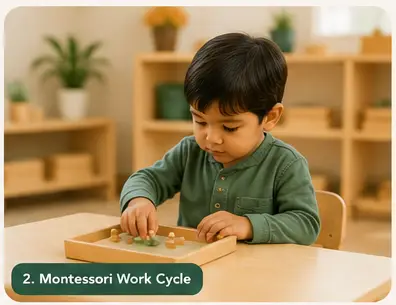
- 2
Montessori work cycle
Children choose from prepared activities and stay with their work for as long as purposeful concentration calls.
- 3
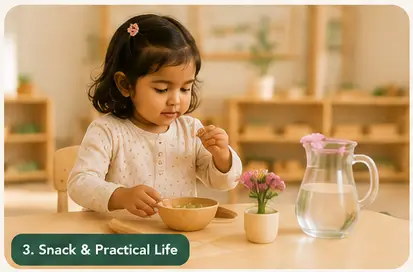
Practical life & snack
Everyday routines become opportunities to participate, communicate and care for oneself.
- 4
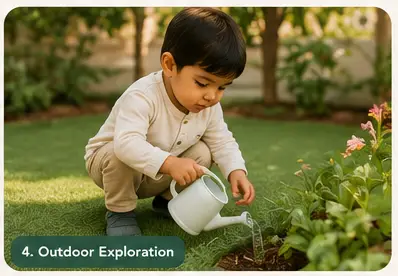
Outdoor movement
Fresh air and whole-body movement offer space to balance, observe and explore.
- 5
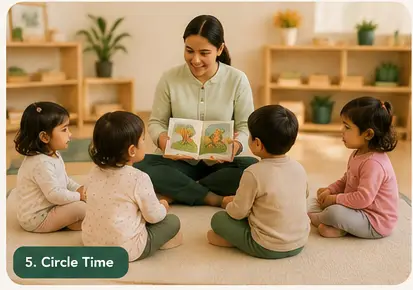
Songs, stories & connection
Shared language and music build vocabulary, joy and a growing sense of community.
- 6
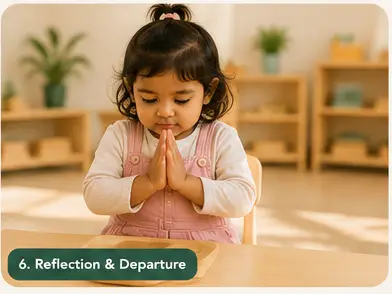
Transition home
A calm close gives the day a recognisable ending and supports the next transition.
The Montessori guide
Guided carefully. Never rushed.
A prepared adult observes first, introduces with precision and offers warm, attentive care while protecting the child’s opportunity to try.
Observe
Notice readiness, interest, energy and the child’s way of approaching an activity.
Introduce
Offer a clear, economical demonstration and language appropriate to the moment.
Support
Help only as much as needed, preserving the child’s ownership of the effort.
Step back
Allow repetition, concentration and discovery to continue without unnecessary interruption.
Instead ofDoing it for the child
The Montessori invitationHelping the child learn to do it
Real toddler moments
Inside the toddler environment
Purposeful work, quiet concentration, movement and connection—small moments that reveal how toddlers participate in a prepared Montessori environment.
Across Bengaluru
Find a Montessori community near you
Explore all seven Freethinking School campus pages. Toddler Program availability can be confirmed with admissions for the campus you prefer.
Koramangala
S.T. Bed, Koramangala
Sarjapur
Sarjapur, Bengaluru
Bellandur
Bellandur, Bengaluru
Harlur
Harlur, Bengaluru
Prestige Finsbury Park
Bagalur Road, Bengaluru
Prestige Finsbury Hyde
Bagalur Road, Bengaluru
Not sure which location fits your family?
Ask AdmissionsToddler Program questions
A clearer beginning for parents
Helpful starting points about the Montessori experience. Operational details will be confirmed directly for the selected campus.
01What age is the Montessori Toddler Program designed for?
The Toddler Program is designed around the developmental needs of children from 1.8 to 3 years. Admissions can help families consider readiness and the most suitable next step for their child.
02What happens during the Montessori work cycle?
Children choose from carefully presented activities, explore with concentration, repeat as needed, complete the activity and restore it for the community. The guide observes and offers help at considered moments.
03Does my child need to be independent before joining?
No. Independence is not an entry requirement. The environment is designed to offer small, achievable opportunities for children to participate and gradually do more for themselves.
04How does Montessori encourage independence?
Child-sized furniture, accessible materials, clear routines and real practical activities allow children to make choices, practise skills and experience the satisfaction of meaningful contribution.
05How does Montessori support language development?
Toddlers encounter rich spoken language through respectful conversation, precise naming, songs, stories, books and the natural communication that happens throughout the day.
06What is Practical Life?
Practical Life is purposeful everyday work such as carrying, pouring, transferring, cleaning, arranging and caring for the environment. These experiences support coordination, concentration, order and confidence.
07How is movement incorporated?
Movement is woven through the environment. Children move between activities, carry materials, coordinate fine-motor work and explore opportunities for balance and whole-body movement indoors and outdoors.
08How do children transition into the environment?
The aim is a gentle transition built through familiarity, predictable routines, responsive relationships and communication between families and educators. Final campus-specific transition practices will be discussed directly with admissions.
09What does the Montessori guide do?
The guide prepares the environment, observes closely, introduces materials, supports communication and steps back when the child is productively engaged. The child’s individual pace remains central.
10How is Montessori different from conventional preschool?
Montessori places strong emphasis on a prepared environment, purposeful hands-on materials, freedom within clear limits, uninterrupted concentration and development at an individual pace.
11How do parents remain connected?
Parent-school partnership is built through communication, shared developmental understanding and opportunities to discuss the child’s experience. Specific communication practices can be confirmed with the selected campus.
12What happens after the Toddler Program?
The next stage is the Primary Montessori Program for children approximately 3–6 years, where learning continues through Practical Life, Sensorial, Language, Mathematics and Culture.
13How can parents visit a campus?
Use the Schedule a Campus Visit action on this page to begin an enquiry through the approved admissions system. The team can then help you explore the appropriate campus and program.
Begin here
1.8–3 yearsToddler Montessori
Movement · Language · Independence · BelongingThe journey continues
3–6 yearsPrimary Montessori
Practical Life · Sensorial · Language · Mathematics · CultureExplore the Primary ProgramBegin their Montessori journey
A lifelong love of learning begins here
Visit the prepared environment and see how curiosity, intrinsic motivation and purposeful work help every child learn with joy.