
Montessori mathematics
Making quantity visible before asking the child to hold it in abstraction
Montessori mathematics progresses from physical quantities and relationships toward symbols, operations, memorisation and increasingly abstract reasoning.
01 / Direct answer
How does Montessori teach mathematics?
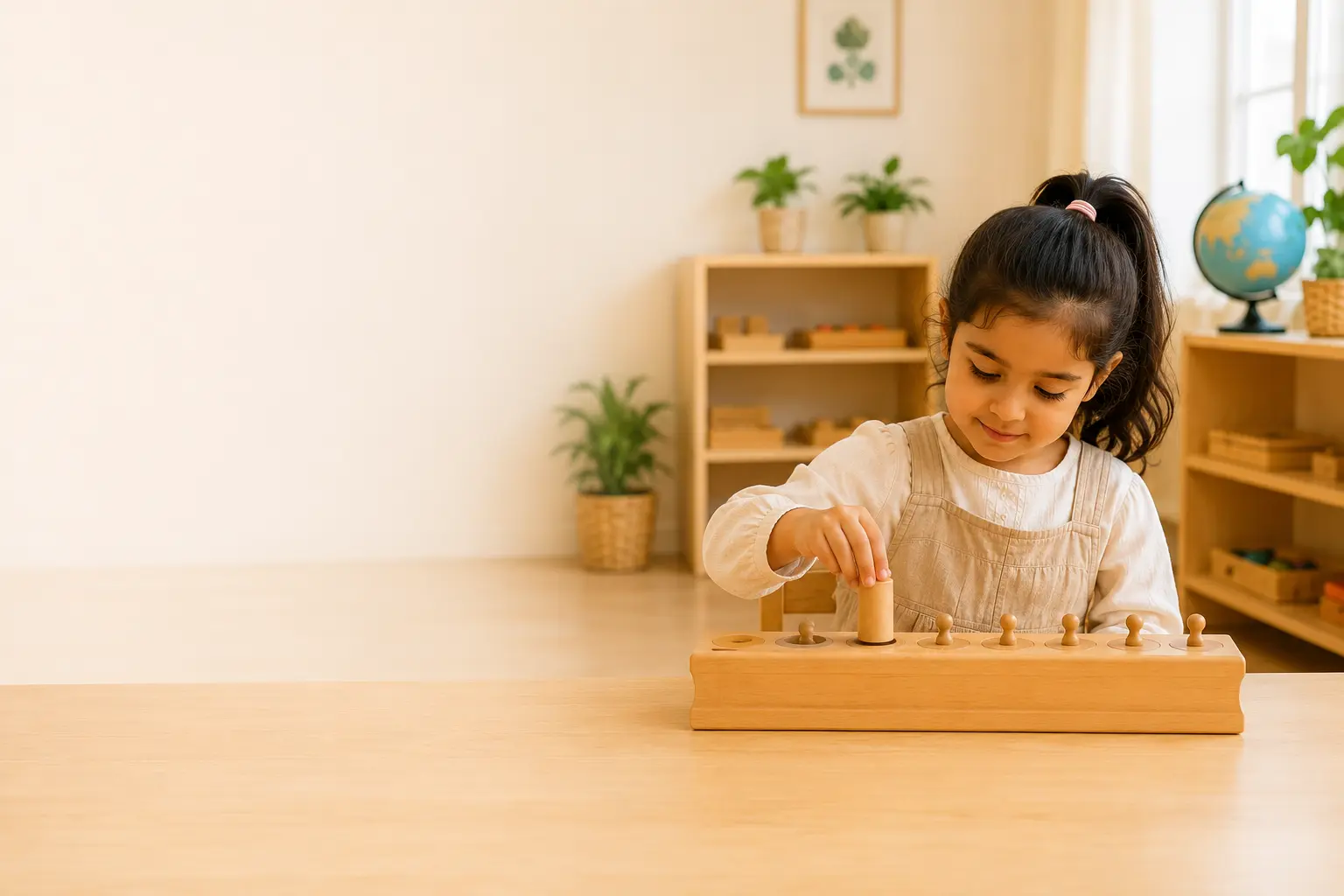
Montessori mathematics introduces number through carefully sequenced concrete materials. Children first experience quantity, then symbols, then associate the two. Place value and operations are made physically visible before the materials gradually recede and abstract calculation takes over.
02 / Understand the principle
01
Quantity before symbol
A written “7” is a compact symbol. It does not contain sevenness by itself. Montessori therefore gives the child opportunities to build, count and compare actual quantities before expecting the symbol to carry full meaning.
When quantity is physically represented, “more”, “less”, sequence and cardinality are not only verbal explanations. They are visible relationships.
02
Association: bringing symbol and quantity together
After children have worked separately with quantity and numerals, materials deliberately connect them. The child can match what a symbol says with what a quantity feels and looks like.
This association helps prevent early mathematics from becoming symbol manipulation without stable numerical meaning.
03
The decimal system can be held in the hand
Unit, ten, hundred and thousand quantities are represented concretely, allowing place value to become spatial and proportional. A child can see that ten units exchange for a ten, ten tens for a hundred, and ten hundreds for a thousand.
Operations with large quantities can therefore be introduced as transformations the child can enact before relying on written algorithms.
04
Operations emerge as actions on quantity
Addition combines, subtraction removes, multiplication repeats equal quantities and division distributes. Montessori materials allow children to perform these relationships physically and later represent them symbolically.
The goal is not to keep children dependent on manipulatives. The materials are a bridge. As patterns become internal, children move toward mental and written abstraction.
05
Memorisation follows understanding
Number facts still matter. Montessori simply aims to build them on meaningful relationships and repeated experience. Materials for combinations and tables support practice until recall becomes efficient.
Understanding and fluency are not opposites; the sequence is designed so one supports the other.
03 / In the classroom
A concrete-to-abstract progression
The exact sequence varies with readiness, but the developmental logic remains consistent.
Experience quantity
The child counts physically distinct units or graded quantities and learns that number describes an amount.
Learn the symbols
Numerals are introduced as names for quantities the child is beginning to understand.
Associate quantity and symbol
The child pairs a numeral with the corresponding amount and checks one-to-one correspondence.
Operate with materials
Large-number operations become visible actions such as combining, exchanging or distributing.
Move toward abstraction
As relationships become internalised, the child relies less on material and more on symbolic and mental calculation.
04 / Developmental significance
Why handling quantity matters
Place-value understanding
Physical proportionality gives ones, tens, hundreds and thousands a relationship rather than presenting them only as columns on paper.
Mathematical language
Terms such as greater, fewer, equal, unit, ten and hundred attach to experienced relationships.
Error awareness
Many materials allow children to see whether a count, sequence or exchange is coherent.
Abstraction with meaning
Symbols eventually become efficient because they stand for relationships the child has already manipulated and observed.
05 / Common misunderstandings
What this principle does—and does not—mean
Misunderstanding
Montessori mathematics is only hands-on play.
In practice
The materials belong to a systematic progression toward symbols, operations, fact fluency and abstract reasoning.
Misunderstanding
Children never memorise number facts.
In practice
Fluency is developed, but Montessori typically establishes conceptual relationships before expecting efficient recall.
At The Freethinking School
How this appears across our Montessori programs
Toddler mathematics is largely indirect: order, one-to-one action, sequence, language, matching and classification prepare the ground.
The Primary Program introduces formal number, decimal-system and operations sequences as readiness emerges, moving progressively toward abstraction.
07 / Parent questions
Frequently asked questions
01Why does Montessori use concrete math materials?+
They make quantity and mathematical relationships visible and manipulable before children are expected to work only with abstract symbols.
02When do Montessori children learn numerals?+
Numeral symbols are introduced when children have enough readiness to connect the symbols meaningfully with quantity.
03How does Montessori teach place value?+
The decimal system is represented concretely so units, tens, hundreds and thousands can be seen, counted, exchanged and compared.
04Does Montessori teach addition and subtraction?+
Yes, along with multiplication and division. Operations are first made concrete and then progressively abstract.
05Do Montessori children learn multiplication tables?+
Yes. Materials and repeated practice support understanding of combinations and eventual fact fluency.
06When are worksheets used in Montessori math?+
Practice formats vary by school and stage, but paper notation generally follows or accompanies conceptual work rather than replacing it at the beginning.