Montessori Primary · 3–6 years
Where curiosity becomes capability.
A three-year Montessori journey where children progressively develop concentration, language, mathematical thinking, confidence and ownership of learning.
- Explore
- Concentrate
- Understand
- Master
- Lead
01 / Learning how to learn
Montessori Primary Program
The Montessori Primary Program serves children between the ages of 3 and 6 years. The overall goal of a Montessori class is to provide an environment that meets the needs and tendencies of the child at each stage of their development.
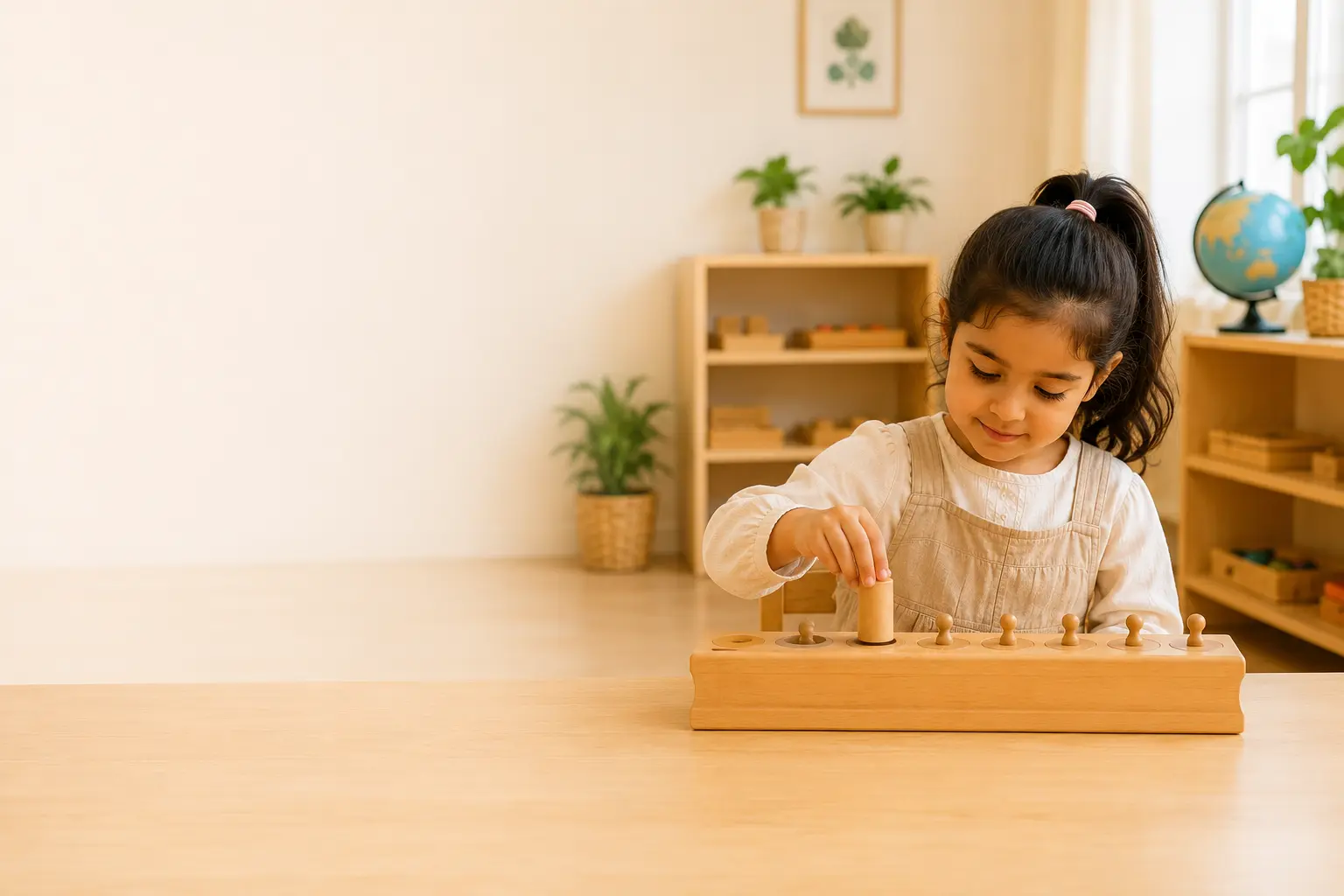
A Primary student works with a globe. By encouraging exploration, independence, personalised education, and freedom within limits, the child is called to work within the learning environment to “unfold” their potential at their own pace. The pace of the young child is respected with the understanding that the particular learning path of each child cannot be hurried. With an authentic learning environment that fosters such independence and freedom, the young child acquires the ability to problem-solve and develop a better understanding of self, while balancing time within a consistent and predictable place.
The Montessori three-year cycle
Three years. One continuous journey.
Children do not all reach identical milestones on an identical timetable. The sequence creates continuity while the guide responds to individual readiness.
01 / 3–4 years
Explore
The child absorbs the environment, practises practical independence and builds vocabulary, coordination and early concentration by observing and doing.
- Practical independence
- Sensorial exploration
- Vocabulary growth
- Early mathematical foundations
02 / 4–5 years
Connect
Ideas begin to connect. Language expands, mathematical relationships become clearer and the child sustains increasingly complex work with growing social confidence.
- Longer concentration
- Logical relationships
- Expanding language
- Complex material
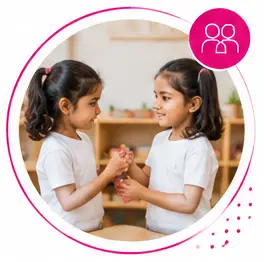
03 / 5–6 years
Master & Lead
The oldest children consolidate knowledge, move toward abstraction, solve problems and become responsible leaders within the mixed-age community.
- Reading and expression
- Abstract thinking
- Sustained independent work
- Leadership and responsibility
02 / Why continuity matters
Growth needs continuity.
Remaining within a stable mixed-age community gives children time to belong, deepen, consolidate and eventually lead.
Emotional security
Familiar people, rhythms and expectations create space for confident exploration.
Individual progression
The child can advance in each area according to readiness rather than a whole-class pace.
Deep learning
Time, repetition and connected materials allow understanding to become durable.
Leadership
The child who once watched eventually models capability for others.
Community
Children experience belonging, contribution and responsibility across three ages.
Mastery
Earlier experiences can be revisited, extended and consolidated over the full cycle.
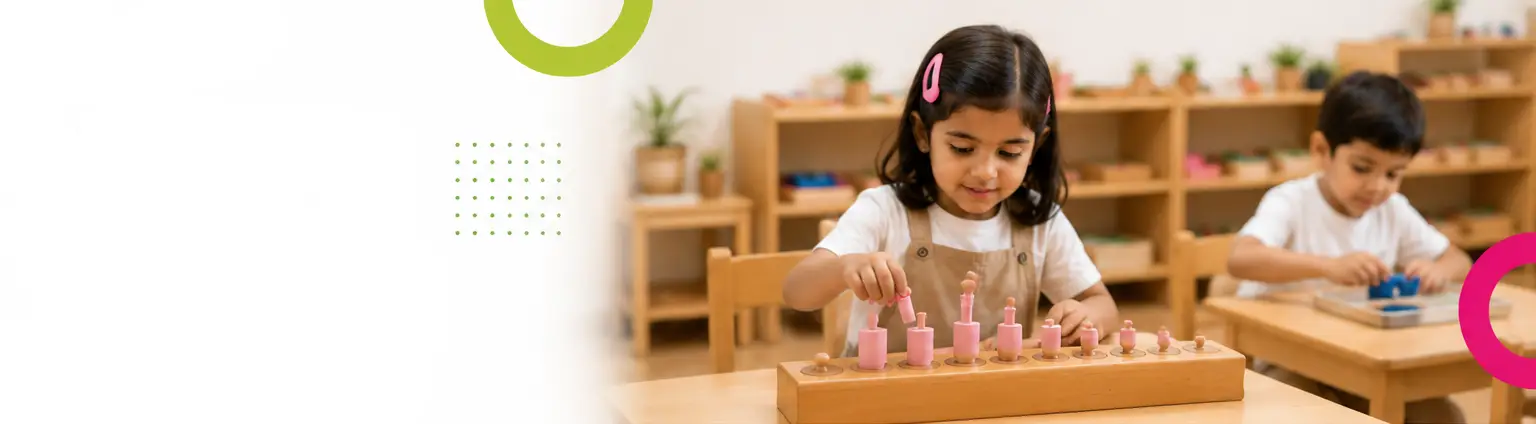
The prepared environment
A classroom built for independent learning.
Materials have a place. Sequences are visible. Children can choose meaningful activity, receive presentations, repeat work, collaborate, complete and restore without waiting for an adult to manage every movement.
Designed so the child can increasingly think: “I know what comes next.”
Learning through purposeful experience
The hand prepares the mind for understanding.
Each area has its own progression, yet the child experiences one connected world of movement, language, logic, culture and responsibility.
Capability begins in everyday action
Everyday actions build extraordinary capabilities.
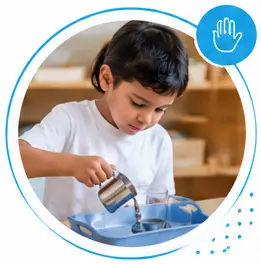
Pouring, preparing, cleaning, carrying and caring are not “fun chores.” They are precise sequences that coordinate movement, organise thought and give the child a real role in the community.
Purposeful activity → controlled movement → concentration → confidenceExperience before abstraction
Before children understand ideas, they experience them.
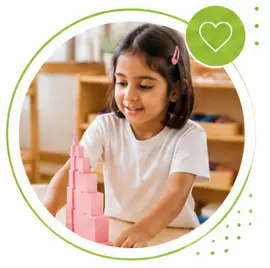
Sensorial materials isolate qualities such as size, shape, colour, dimension, texture, sound and weight, helping children compare, sequence and classify what they perceive.
Notice → compare → classify → form a mental relationship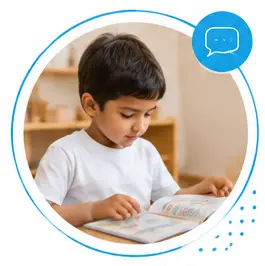
Expression takes shape
From spoken language to reading, writing and expression.
Conversation, precise vocabulary, sound awareness, symbols and word-building experiences form a connected pathway. Children progress through purposeful practice without being held to one fixed reading age.
Conversation → vocabulary → sounds → symbols → words → expression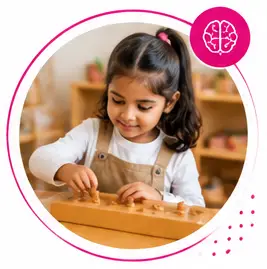
The mind follows the hand
Mathematics you can touch before you hold it in your mind.
Quantity, symbols, place value, operations, patterns and relationships become visible through materials. Physical experience progressively becomes mental representation and, when the child is ready, abstraction.
Concrete → representational → abstract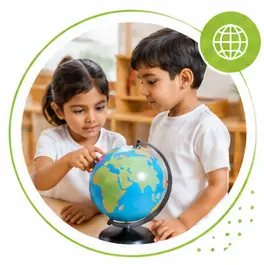
A connected world
Learning is connected to the world around them.
Geography, nature, science, early history concepts, art, music and movement invite children to classify, observe, experiment and ask larger questions about the world they inhabit.
Observe → question → investigate → connect03 / Concrete to abstract
First they hold the relationship. Then they hold it in the mind.
- 01Concrete
Quantity and relationships are experienced physically.
- 02Representational
Experience connects with symbols and recorded ideas.
- 03Abstract
The child increasingly works mentally from understood foundations.
The uninterrupted work cycle
Time to go deep.
A substantial uninterrupted period allows children to follow the whole arc of learning. This is where repetition becomes mastery and purposeful choice becomes an independent study habit.
- 01Choose
- 02Engage
- 03Repeat
- 04Understand
- 05Master
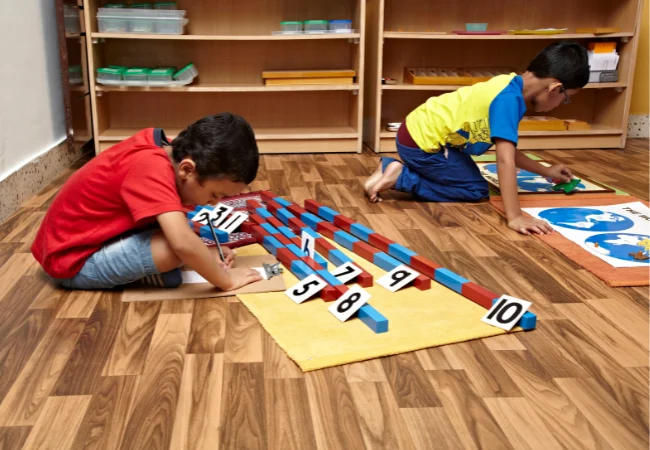
Purposeful choice · appropriate challenge · repetition · completion
Concentration isn't demanded. It is built.
The mixed-age community
Three ages. One learning community.
Knowledge and behaviour circulate naturally as each child moves from watching, to participating, to leading.

Younger children observe.
They absorb language, order, movement and possibility from the community around them.
Middle-year children connect.
They participate with growing confidence and work at increasing levels of complexity.
Older children lead.
They reinforce mastery by demonstrating, mentoring and caring for the shared environment.
04 / Leadership through belonging
The child who once watched becomes the child others watch.
In the final stage of the cycle, responsibility becomes visible. Older children can model routines, explain ideas, support younger peers and experience the confidence that comes from genuine contribution.
- Leadership
- Empathy
- Communication
- Responsibility
- Mastery through demonstration
The Montessori guide
Present. Observe. Step back.
Expert guidance is not constant adult control. The guide studies readiness, introduces material precisely, protects concentration, tracks progression and knows when support will help—and when interruption will not.
Observe readiness
Connect child and work
Present with precision
Protect concentration
Follow progression
A day in Primary
A purposeful rhythm, not a race against the clock.
Exact routines vary by campus. This sequence shows the developmental flow without inventing unverified timings.
- 01
Arrival
A calm entry and purposeful start to the community.
- 02
Uninterrupted work cycle
Time to choose, engage, repeat, complete and restore.
- 03
Guide presentations
Individual or small-group introductions matched to readiness.
- 04
Outdoor movement
Whole-body movement, observation and connection with nature.
- 05
Food & social experience
Responsibility, conversation, grace and courtesy in daily life.
- 06
Culture & creativity
Shared exploration through stories, music, art, science and the wider world.
- 07
Reflection & transition
An orderly close that helps children carry responsibility forward.
05 / From dependence to ownership
“What should I do?” becomes “I know what comes next.”
- Needs frequent direction
- Chooses familiar work
- Completes complex sequences
- Manages materials independently
- Plans and sustains work
- Takes responsibility for learning
What children may gain by six
By six, the difference is larger than what they know.
Development is individual. These are capabilities the full Primary experience is designed to cultivate—not identical guaranteed outcomes.
Independent thinker
Makes purposeful choices and develops reasons for them.
Concentrated worker
Can remain with appropriately challenging activity for longer periods.
Confident communicator
Increasingly expresses needs, questions and ideas.
Mathematical thinker
Builds abstract understanding on concrete relationships.
Emerging reader & writer
Progresses through a structured language journey.
Problem solver
Tries, notices, evaluates and adjusts.
Responsible community member
Participates with growing awareness of people and place.
Independent learner
Approaches work without constant adult direction.
Beyond Montessori
Ready for the classroom. More importantly, ready to learn.
Many parents ask what happens when their child eventually moves into a traditional school. Completing the full 3–6 cycle is designed to build transferable foundations for that next environment.
Grade 1 and the early primary years
When school changes, their ability to learn goes with them.
Academic foundations
Language, reading, writing, mathematical reasoning and broad general knowledge develop through connected experience.
Independent study habits
Years of choosing, concentrating, completing sequences and managing materials establish a different relationship with work.
Less constant direction
The aim is a child who can begin, try, continue and ask for help appropriately—not one who must be prompted through every step.
Confidence with new learning
Children are familiar with observing demonstrations, experimenting, correcting and progressing through repetition.
The goal isn't to raise a child who can only complete today's worksheet.It is to develop a child who knows how to learn tomorrow's lesson.
Intellectual independence
“I can learn by myself.”
The parent role evolves
From helping them do everything to watching them take ownership.
Independence does not mean parents stop helping. It means the adult-child relationship can increasingly make room for encouragement, listening, partnership and appropriately timed guidance.
- Encourage effort
- Listen to thinking
- Offer structure
- Allow productive struggle
- Guide when genuinely needed
Real Primary moments
Inside the Primary environment.
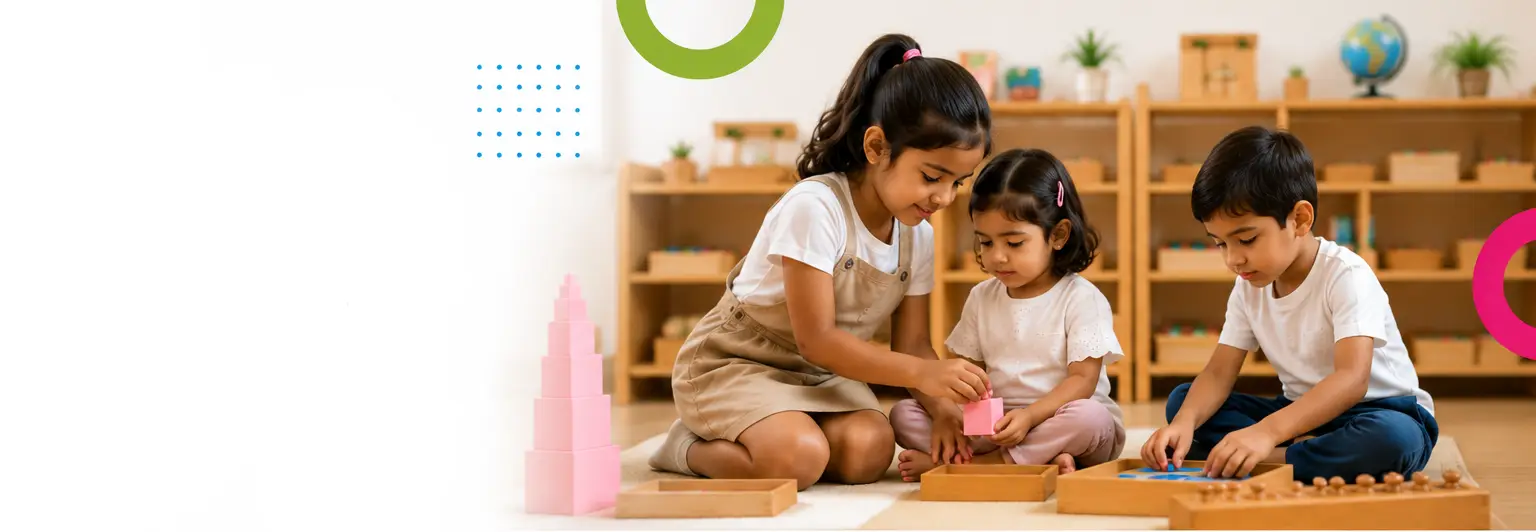
Mathematics, language, Practical Life, Sensorial exploration, culture and peer learning—different experiences connected by concentration and purpose.
Development in everyday life
What parents begin to notice.
These are possible observations, not guaranteed milestones. Growth can appear differently for every child.
- 01“Let me finish this.”
- 02Longer concentration
- 03More complex questions
- 04Explaining an idea
- 05Organising their own work
- 06Helping a younger child
- 07Trying another solution
- 08Pride in mastery
Home and school
Independence grows through understanding, not pressure.
Developmental conversations
Families and educators look at patterns of growth rather than isolated performances.
Shared understanding
Clear communication helps parents understand the progression behind the materials.
Independence at home
Thoughtful opportunities help the child contribute, choose and take responsibility beyond school.
Continuity
Respectful language and consistent expectations help learning habits travel between environments.
Primary Program questions
Clear answers for the next three years.
Program principles are explained here. Campus-specific operational details should be confirmed directly with admissions.
01What age is the Montessori Primary Program for?
The Primary Program is designed around the developmental period from approximately 3–6 years. Admissions can help families understand the appropriate next step for their child.
02Why is Primary Montessori a three-year cycle?
The three-year cycle gives children continuity in a stable mixed-age community. They can progress individually, revisit work at greater depth and eventually consolidate learning by taking greater responsibility within the environment.
03Why are children ages 3–6 together?
Younger children observe, middle-year children participate with growing confidence and older children model capability and leadership. Each child occupies different roles as they progress through the community.
04What does a child learn in Montessori Primary?
The environment integrates Practical Life, Sensorial, Language, Mathematics, Culture, Science, creativity, movement and social development. The emphasis is on connected understanding rather than isolated syllabus coverage.
05Does Montessori teach reading and writing?
Yes. Spoken language, vocabulary, sound awareness, symbols, word building, reading, writing and expression form a progressive pathway. The pace remains individual rather than tied to a guaranteed reading age.
06How is mathematics taught?
Children first experience quantity and mathematical relationships through concrete materials. They progressively connect those experiences to symbols, representations and abstract thinking.
07Will my child be prepared for Grade 1?
Completing a strong Primary cycle is intended to provide foundations in language, mathematics, concentration, task completion, self-management and independent learning that support transition into the early primary grades. Individual development varies.
08Can Montessori children transition to a traditional school?
Montessori children regularly practise listening to presentations, following sequences, completing work, asking for help appropriately and adapting their knowledge to new problems. These learning habits can support a successful transition to a different classroom structure.
09Will my child adapt to desks, textbooks and a conventional classroom?
A new environment always requires adjustment. The Primary cycle builds transferable habits—concentration, responsibility, problem-solving and the ability to follow a process—that can help children meet new routines and expectations.
10Does Montessori prepare children to study independently?
Independent learning is a central developmental aim. Children progressively practise choosing suitable work, organising materials, sustaining attention, checking progress, completing sequences and seeking help when genuinely needed.
11What if my child progresses faster or slower in one area?
Montessori progression is individualized. The guide observes readiness and connects each child with appropriate work, allowing development to move at different rates across different areas.
12What is an uninterrupted work cycle?
It is a substantial period in which children can choose purposeful work, engage, repeat, correct, complete and restore without unnecessary interruption. This gives concentration and mastery time to develop.
13What is the role of the Montessori guide?
The guide prepares the environment, observes readiness, presents materials precisely, tracks progression, protects concentration and intervenes thoughtfully without taking ownership of the child’s work.
14Why is completing the third year important?
The final year gives children the opportunity to consolidate earlier experience, move toward abstraction and become capable older members of the mixed-age community. This leadership role is a meaningful part of the full cycle.
15What happens after age six?
Families may transition into a conventional primary setting or another appropriate next-stage environment. The goal is that the child carries forward strong learning foundations, self-management and confidence with new work.
16How can we visit a Freethinking School campus?
Use the Schedule a Campus Visit action on this page. Admissions can help you explore the most suitable campus and confirm current Primary Program availability.
Toddler Montessori
Explore the Toddler Program ←You are here
3–6 yearsPrimary Montessori
Explore · Concentrate · Understand · Master · LeadConfident transition
Learning foundations travel forwardAcross Bengaluru
Find your Freethinking School community.
Explore all seven campus pages. Primary Program availability can be confirmed with admissions for the location you prefer.
Koramangala
S.T. Bed, Koramangala
Sarjapur
Sarjapur, Bengaluru
Bellandur
Bellandur, Bengaluru
Harlur
Harlur, Bengaluru
Prestige Finsbury Park
Bagalur Road, Bengaluru
Prestige Finsbury Hyde
Bagalur Road, Bengaluru
Experience Primary Montessori
See what independent learning looks like before age six.
The best way to understand a Montessori Primary environment is to watch children choose, concentrate, explore and learn for themselves.