
Social and emotional growth
Self-discipline grows through participation, not constant control
Montessori social development is embedded in freedom within limits, grace and courtesy, mixed-age community, practical responsibility and repeated experiences of competence.
1 / Direct answer
How does Montessori support social and emotional development?
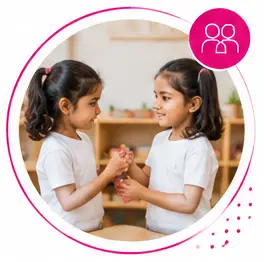
Montessori supports social and emotional growth through daily structures rather than a separate behaviour programme: children make choices within limits, wait for shared materials, practise grace and courtesy, resolve ordinary conflicts, care for their environment and contribute to a mixed-age community.
2 / Understand the principle
01
Freedom only works when limits are dependable
A child can choose meaningful work because the boundaries of the environment are clear. They may move, speak and collaborate, but not in ways that damage materials, compromise safety or repeatedly disturb another person’s concentration.
Predictable limits reduce the need for continuous adult negotiation. Children gradually learn that their freedom exists alongside the freedom of others.
02
Grace and courtesy makes social behaviour concrete
Young children are often told to share, be nice, listen or use manners. Montessori breaks social expectations into observable actions: how to greet, wait, offer help, interrupt, carry something around another person’s work or decline politely.
These behaviours can be demonstrated, practised and revisited just like other classroom skills.
03
Waiting is built into the environment
If one material is in use, another child cannot simply take it. They may observe, wait or choose something else. The child experiences frustration in a manageable social context and discovers alternatives.
This is different from teaching patience only through adult instruction. The environment gives patience a reason.
04
Competence can become emotional confidence
A child who repeatedly experiences “I can carry this”, “I can fix this spill”, “I can ask for a turn”, or “I can finish this difficult sequence” builds confidence on evidence.
Montessori independence is therefore emotional as well as practical. The child’s sense of capability is fed by real successful action.
05
From adult-imposed discipline toward self-discipline
Young children still need adults to hold boundaries. Montessori does not pretend otherwise. But the long-term aim is that children increasingly regulate movement, attention and social behaviour because they understand the environment and experience the satisfaction of purposeful participation.
External control is gradually replaced, where development allows, by internal order.
3 / In the classroom
Social development in ordinary moments
Most social learning happens between formal lessons.
Waiting for a material
The child notices another person is using the work they want, pauses, and selects an alternative or waits nearby without interfering.
Repairing a disruption
After bumping another child’s work, the child helps restore it rather than simply receiving a lecture about being careful.
Offering help appropriately
Children learn that help should be offered rather than imposed, and that another person may say no.
Belonging through contribution
Serving snack, watering a plant or restoring a common space gives the child a real role in community life.
4 / Developmental significance
Capacities strengthened over time
Self-regulation
Children repeatedly practise pausing, choosing, waiting, completing and adjusting behaviour to a shared environment.
Empathy
Mixed-age life and care routines make other people’s needs visible in daily practical ways.
Conflict resolution
Guides help children name needs, listen, repair and negotiate rather than solving every disagreement on their behalf.
Belonging
Responsibility for real classroom life communicates that the child is a participant, not merely a recipient of care.
5 / Common misunderstandings
What this principle does—and does not—mean
Misunderstanding
Montessori independence makes children less collaborative.
In practice
Independence reduces unnecessary dependence on adults while mixed-age community, shared materials and classroom care create substantial social interaction.
Misunderstanding
Montessori avoids discipline.
In practice
Limits are explicit and consistently protected. The distinction is that the long-term goal is increasing self-discipline rather than permanent dependence on external control.
At The Freethinking School
How this appears across our Montessori programs
Toddler communities introduce early grace and courtesy, care routines, turn-taking, movement boundaries and the language needed for social participation.
Primary communities deepen responsibility as children work for longer periods, share a wider environment and become more capable of resolving routine social situations with guidance rather than adult takeover.
7 / Parent questions
Frequently asked questions
01How does Montessori teach social skills?+
Through grace-and-courtesy presentations, mixed-age community life, shared materials, classroom responsibilities and guided conflict resolution embedded in daily routines.
02What does freedom within limits mean socially?+
Children can make real choices as long as those choices respect safety, materials, classroom expectations and other people’s freedom to work.
03Does Montessori teach children to share?+
Children learn to respect materials that are in use, wait for turns and participate in shared classroom life. Forced immediate sharing is not the only route to generosity.
04How are conflicts handled in Montessori?+
Guides intervene according to age and need, helping children use language, listen, repair harm and find workable solutions while maintaining clear boundaries.
05Does independence make Montessori children less attached to adults?+
No. Independence means reducing unnecessary help, not reducing secure relationships. Adults remain available, observant and responsive.
06What is the difference between discipline and self-discipline in Montessori?+
External discipline relies mainly on adult control. Self-discipline develops when the child can increasingly regulate behaviour, movement and attention from an internalised understanding of limits and purpose.