
The Montessori Approach
Montessori is not a collection of materials. It is a way of understanding development.
Explore the ideas, classroom structures and learning areas that work together inside an authentic Montessori environment at The Freethinking School.
01 / The whole system
What is the Montessori approach?
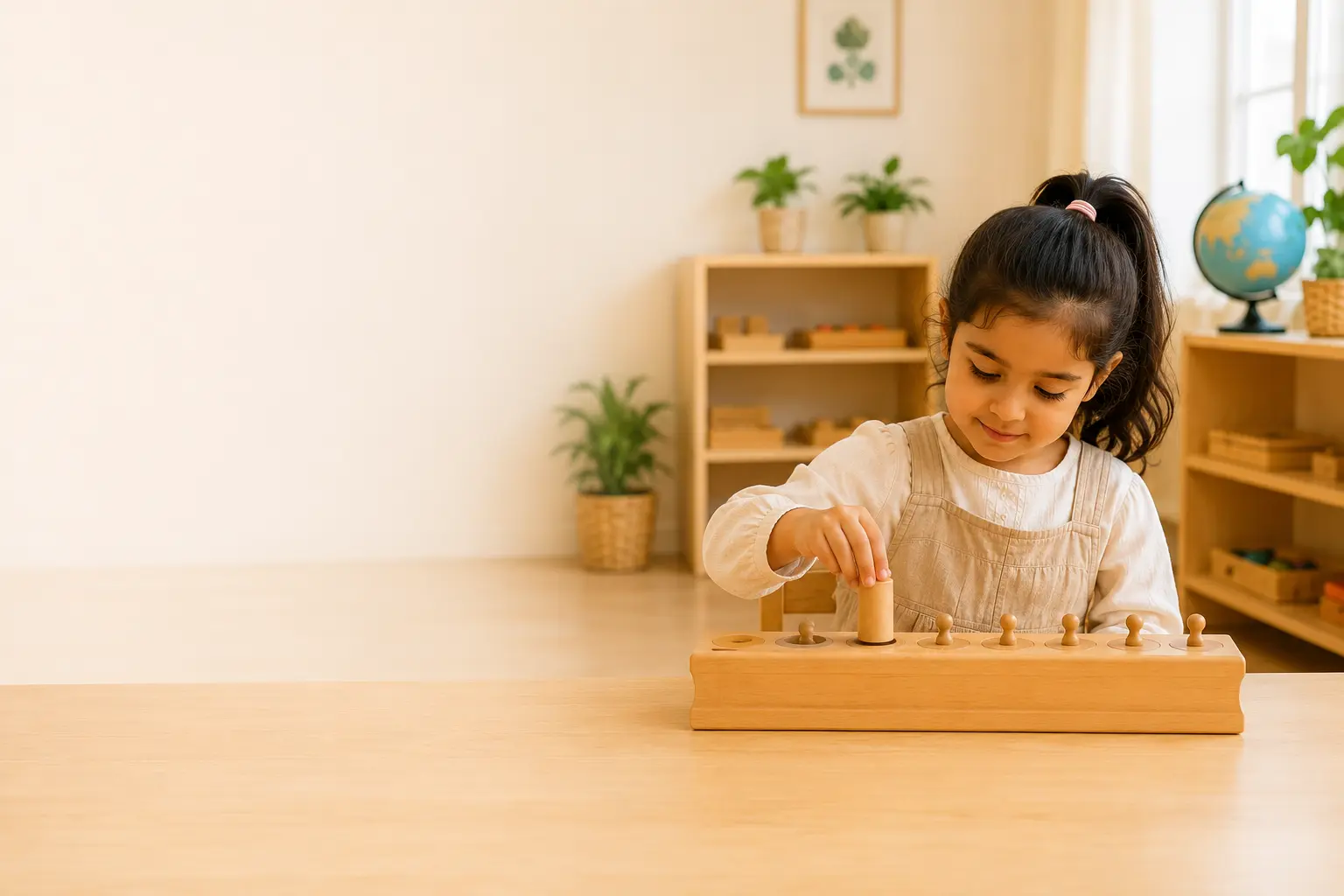
Montessori is a developmental approach to education created by physician and educator Maria Montessori through sustained observation of children. It brings together a prepared environment, trained guide, mixed-age community, purposeful materials, freedom within limits and long periods for self-directed work.
These elements are not independent features. A material cannot do its work if the child is constantly interrupted. Choice becomes chaotic without limits. Independence remains rhetorical if furniture, tools and routines require adult permission for every action. Observation is useful only when the guide knows the developmental sequence well enough to respond to what is seen.
At The Freethinking School, this interconnected view matters. Montessori is not treated as a shelf of attractive activities. It is a way of understanding what children are trying to construct in themselves—and of preparing conditions that make that construction more possible.
02 / Core principles
The ideas you can actually see in a Montessori classroom
Each principle changes something concrete about how the room, adult, materials or daily rhythm is organised.
Observation
The adult watches before deciding what the child needs next.
Sensitive periods
Developmental readiness changes what a child is naturally prepared to practise.
Absorbent mind
Young children take in language, movement and social patterns through lived experience.
Freedom within limits
Choice is real, but bounded by safety, purpose, respect and responsibility.
Purposeful activity
Work becomes meaningful when the child can act, repeat, complete and restore.
Concentration
Uninterrupted engagement is protected because attention develops through use.
Movement and cognition
For young children, thinking is often organised through purposeful movement.
Self-correction
Materials and routines frequently allow the child to discover and revise error.
Concrete to abstract
Ideas are often first made visible and tangible before symbolic representation takes over.
Intrinsic motivation
The environment aims to make mastery and capability rewarding in themselves.
Mixed-age community
Children live among different levels of experience, not only identical-age peers.
Responsibility
Care of self, materials, environment and community is part of the curriculum.
From the Montessori environment
A child may repeat the same activity ten times even after an adult believes it has been “mastered”. From the adult perspective, the task is finished. From the child’s developmental perspective, the repetition may be the work itself.
Montessori asks adults to look beyond the visible product. Repetition may be refining movement, extending concentration, strengthening memory or satisfying a developmental need for order and exactness. What matters is not simply whether a child can complete a task once, but what the child is building through doing it.
03 / Montessori knowledge library
Explore the Montessori system in depth
These pillar pages form one connected knowledge cluster: philosophy, environment, adult role, community and the major curriculum areas.
Montessori Philosophy
The developmental ideas behind observation, sensitive periods, freedom, concentration and self-construction.
Explore →02The Prepared Environment
Why the classroom itself is deliberately designed to make purposeful independence possible.
Explore →03Role of the Montessori Guide
How trained adults observe, present, protect concentration and introduce challenge with careful timing.
Explore →04Mixed-Age Classrooms
How a multi-year community supports continuity, peer learning, leadership and individual pacing.
Explore →05Montessori vs Traditional Education
A respectful comparison of pacing, adult role, movement, assessment and classroom responsibility.
Explore →06Practical Life
How everyday purposeful actions build coordination, order, concentration and real independence.
Explore →07Sensorial Development
How children refine perception by isolating, comparing, grading, classifying and naming qualities.
Explore →08Montessori Mathematics
How quantity becomes visible before children move toward symbols, operations and abstraction.
Explore →09Language and Literacy
How spoken language develops toward sound awareness, writing, reading, comprehension and grammar.
Explore →10Culture and Science
How geography, biology, science, history, art and music help children locate themselves in a connected world.
Explore →11Social and Emotional Growth
How freedom within limits, grace and courtesy, competence and community support self-discipline.
Explore →04 / How the pieces connect
The guide watches for readiness
Movement, repetition, language, error and concentration give clues about what the child is ready to practise next.
The environment makes action possible
Materials are ordered, accessible and sequenced; the child can increasingly act without waiting for unnecessary adult help.
The adult introduces a precise challenge
A concise presentation reveals how to begin without taking over the child’s later exploration.
The child consolidates through work
Uninterrupted time allows practice, self-correction, refinement and deeper concentration.
Concrete experience becomes internal understanding
Materials gradually give way to language, abstraction, independent judgement and more complex responsibility.
Montessori at TFS
The same developmental logic, adapted to different stages
In the Toddler years, movement, language, practical independence and environmental order are especially prominent. In the Primary years, the child enters a wider sequence of Practical Life, Sensorial, Language, Mathematics and Culture while continuing to build concentration, social responsibility and independent work habits.
05 / Parent questions
Frequently asked questions about Montessori
01What is the Montessori method?+
The Montessori method is a developmental educational approach created by Maria Montessori. It combines observation, a prepared environment, mixed-age communities, sequenced materials, freedom within limits and trained guides to support increasingly independent learning.
02Who was Maria Montessori?+
Maria Montessori was an Italian physician and educator whose educational method grew from systematic observation of children and the environments in which they learned.
03What is an uninterrupted Montessori work cycle?+
It is an extended period in which children can choose from appropriate work, receive individual or small-group presentations, repeat activities and move toward deeper concentration without frequent timetable-driven interruption.
04Does Montessori have structure?+
Yes. Montessori classrooms are highly structured through environmental order, material sequences, clear limits, routines, developmental expectations and carefully timed presentations.
05Does Montessori teach academics?+
Yes. Montessori includes systematic curricula in language, mathematics, culture and science, alongside Practical Life, Sensorial development and social learning.
06Why do Montessori children choose their work?+
Choice allows children to follow readiness, repeat for mastery and develop responsibility for learning. Choice is bounded by what has been presented, classroom limits and the guide’s responsibility to maintain balanced progression.
07How does The Freethinking School use Montessori?+
TFS treats the guide, prepared environment, work cycle, mixed-age community, practical responsibility and learning materials as interconnected parts of one developmental system rather than isolated classroom activities.