
Practical Life
Everyday actions with uncommon developmental depth
Practical Life is the Montessori area where children refine movement, attention, sequencing, independence and social participation through real purposeful activity.
01 / Direct answer
What is Practical Life in Montessori?
Practical Life is a Montessori curriculum area built around purposeful everyday actions. It includes care of self, care of the environment, grace and courtesy, and control and coordination of movement. Activities are sequenced so children can practise attention, order and independence through real participation.
02 / Understand the principle
01
Care of self
Fastening clothes, washing hands, serving food, pouring a drink or managing personal belongings are not treated as interruptions to “real learning”. They are part of learning to function capably in the world.
A child who masters a dressing sequence gains more than a buttoning skill. They practise bilateral coordination, memory, persistence and the experience of solving a personal problem without immediately outsourcing it to an adult.
02
Care of the environment
Sweeping, wiping, washing, arranging flowers, cleaning a spill and returning materials establish a relationship between the child and the shared space. The classroom is not maintained invisibly around children; they participate in its order.
This makes responsibility concrete. “Care for your classroom” becomes a sequence of actions the child can actually perform.
03
Grace and courtesy
Greeting, offering help, waiting, interrupting respectfully, serving another person and moving around someone’s work are presented as learnable social behaviours.
Young children often benefit from this specificity. “Be polite” is abstract. “Place your hand gently on my shoulder and wait until I turn to you” is an action that can be rehearsed.
04
Control and coordination of movement
Carrying a tray without rattling, pouring to a line, walking around a mat, opening a container or transferring small objects require the child to slow movement down enough to observe it.
This deliberate movement prepares the body for later fine-motor demands, including pencil control, but its immediate purpose is broader: voluntary control of action.
05
The hidden academic preparation
Practical Life activities contain beginnings, ordered middles and clear endings. The child gathers materials, follows a sequence, notices error, completes the task and restores the set-up.
That pattern is relevant to later mathematics, writing and independent study because academic work also depends on sequencing, working memory, attention and completion.
03 / In the classroom
What Practical Life looks like
The materials are simple enough to recognise and precise enough to demand care.
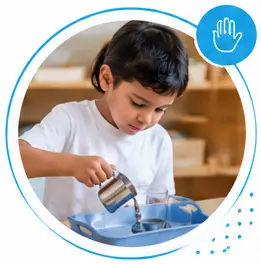
Pouring water
The child estimates quantity, stabilises the jug, coordinates wrist movement, watches the water level and deals with a spill if one occurs.
Food preparation
Spreading, slicing soft food, peeling or serving brings sequencing, hygiene, tool use, language and contribution into one purposeful activity.
Sweeping
The child must identify a problem area, gather debris, coordinate a broom and dustpan and restore the tools afterwards.
Dressing frames
Buttons, zips, buckles or ties isolate fastening movements so children can practise without the pressure of getting dressed at speed.
04 / Developmental significance
Why adults often underestimate Practical Life
Executive function
Multi-step tasks give repeated practice in remembering sequences, inhibiting impulsive movement and checking completion.
Pre-writing control
Whole-arm stability, pincer use, wrist rotation and controlled directional movement appear throughout practical work.
Mathematical habits
Order, one-to-one sequences, exact quantities and logical progression prepare habits that later support mathematical work.
Confidence grounded in competence
“I can do it” becomes credible when the child has genuinely done something useful without unnecessary adult rescue.
05 / Common misunderstandings
What this principle does—and does not—mean
Misunderstanding
Practical Life is just chores.
In practice
The activities are carefully selected, scaled and sequenced to support coordination, concentration, order, independence and social participation.
Misunderstanding
Children should move on once they can complete the task.
In practice
Repetition may continue because precision, fluency and concentration are still developing even after the basic outcome is achieved.
At The Freethinking School
How this appears across our Montessori programs
Practical Life is central in the Toddler Program because care of self, movement and participation answer immediate developmental needs.
In the Primary Program, practical work remains important and also supports the concentration, order and fine-motor control needed for increasingly complex academic sequences.
07 / Parent questions
Frequently asked questions
01What are the four areas of Montessori Practical Life?+
They are commonly described as care of self, care of the environment, grace and courtesy, and control/coordination of movement.
02Why do children pour and transfer in Montessori?+
These activities refine coordination, concentration, sequencing, estimation and independence while giving children a clear purposeful task.
03How does Practical Life prepare children for writing?+
Many activities strengthen hand control, wrist movement, pincer coordination, left-to-right sequencing and the ability to sustain attention through a multi-step task.
04Is cleaning part of Montessori learning?+
Yes. Cleaning a spill, sweeping or restoring materials allows children to care for a shared environment and experience natural responsibility.
05Why use real tools instead of pretend ones?+
Functional tools provide real consequences, genuine purpose and accurate feedback. They are selected and scaled for safe, manageable use.
06Can Practical Life activities be done at home?+
Yes. Dressing, food preparation, pouring, cleaning and organising can all support independence when adults adapt the environment and allow enough time for genuine participation.